
Harriton High School
Used Apple Laptop Webcams
To SPY On Students At Home
Cite the Educational CyberPlayGround, Inc ® APA Style of Citation
Use MLA cite format: "Educational CyberPlayGround" Internet.
Database available online.
https://edu-cyberpg.com
.
Date accessed Month ___ day____, year_____.
2016
Schools spying on students' use of Chromebooks at home
Software Flags 'Suicidal' Students
,
Presenting
Privacy
Dilemma
-- ostensibly for good reasons, but the abuse potential of such
surveillance is enormous.
How To Hack a Webcam
This tutorial is only for Educational Purposes, I did not take any
responsibility of any misuse, you will be responsible for any misuse
that you do. Hacking email accounts is criminal activity and is
punishable under cyber crime.
Lower Merion School District
301 East Montgomery Ave.
Ardmore, PA 19003
610.645.1800
The school district's insurance provider paid all the fines and fees NOT the tax payer.
12/7/11 Paige Robbins vs. Lower Merion School Distric t and The Board of Directors of the Lower Merion School District and Christopher McGinley Superintendent
August 23, 2011The Lower Merion School District has agreed to pay $10,000 to a teen secretly recorded by his school-issued laptop, the fourth settlement with a student since the webcam scandal broke last year. The school board approved the payout at its meeting Monday night, spokesman Doug Young said. Lower Merion paid more than $1.6 million last year to litigate and settle allegations that it spied on students through webcams on the laptops it gave to each of its nearly 2,300 high school students.

1/2012 The Lower Merion School District is $19,500 away from being done with the webcam spying cases.The Board of School Directors approved the final settlement Monday, to be paid to former Harriton High student Josh Levin.Levin filed his suit last year, claiming the district-issued laptop he took home snapped photos of him with a webcam. Main Line Times reports the district will pay $10,000 of the settlement and its insurance company will pay the rest. The district denies any wrongdoing.
June 8, 2011
Former Harriton High graduate Joshua Levin has filed a new webcam
suit against Lower Merion.
http://mainlinemedianews.com/articles/2011/06/08/main_line_times/news/doc4def4060da1af777252860.txt?viewmode=fullstory
According to the suit, Levin was a student at Harriton High School
when he was issued a laptop computer by the district. The family in
this latest suit says they only learned about the monitoring when
they got a letter from the district's attorney, Hank Hockeimer, that
was dated June 8, 2010. The district was required to send out
letters to all students who had the security feature activated on
their computers. Hockeimer's letter told Levin that 4,404 webcam
photos and 3,978 screenshots were recovered between Sept. 22, 2008,
and March 12, 2009. Students and their parents were given the option
to viewing the recovered images.
“Unbeknownst to Plaintiff, and without his authorization, Defendants
had been spying on the activities of Plaintiff by Defendants'
indiscriminate use of and ability to remotely activate the webcams
incorporated into each laptop issued to students by the school
district,” the complaint reads in part.
“Plaintiff's younger brother noticed that the light in the camera
would go off and on at odd times, wondering if the family was being
'spied on,'” the complaint reads. “Plaintiff's mother dismissed this
idea as absurd, as the notion that the school district was secretly
monitoring and taking pictures of students was simply
incomprehensible and beyond all rational belief. Plaintiff's father
was told and believed that the light meant that the laptop was
charging.”
Levin says his parents subsequently received a letter from the
district around June 2010, advising them that "4,404 webcam
photographs and 3,978 screenshots" were remotely captured by the
district from the laptop he was issued. The letter then instructed
Levin that if he wanted to view the fruits of the district's
surveillance, he'd have a one-hour window on a specific day in June
to do so at a federal courthouse, according to the suit. Levin says
he accepted the offer, "and was shocked, humiliated and severely
emotionally distressed at what he saw."
Norman Perlberger, of Bala Cynwyd, Pa is the attorney for Levin
claims that many images captured by the laptops may have depicted
minors and their parents "in compromising or embarrassing
positions," including in "various stages of dress or undress."
Bottom Line 10/11/10
Lower Merion School District pays $610,000 to settle the lawsuit. Student Blake Robbins will get $175,000 placedin trust and his lawyer, Mark Haltzman, gets $425,000 for his work. The second student Jalil Hassan will get $10,000. The district's insurer Graphic Arts Mutual Insurance Company has agreed to pay $1.2 million toward legal and settlement costs. The FBI investigated but declined to bring a criminal wiretap case.
The school district acknowledged
it took nearly 60,000 snapshots from student computers, without
their knowledge, from September 2008 to February 2010. The district
has admitted that the LANrev system it used had a program called
TheftTrack that could snap webcam photos, take screenshots and
record IP addresses every 15 minutes.
John Steinbach Chief Information Officer Vestige Ltd.
www.vestigeltd.com/ Medina, OH owned by
Lawyer Don Wochna
was hired to conduct his own forensic investigation into
district-owned computers as a follow-up to one done by Level-3
Communications for the district. That investigation culminated in
the report that was made public in May detailing an estimated 60,000
LANrev images found on district computers. He reviewed a mirror
image of the hard drive that was on the computer used by Michael
Perbix, one of two district employees who had access to the program
that was able to remotely activate the student-issued computers.The
computer used by Perbix is being checked since he was the employee
who activated the monitoring system on the computer issued to Blake
Robbins. Steinbach will run his own program to look for all images
on the computer. The reason is that if a photo from the LANrev
system was saved using another software program such as Photoshop,
it will no longer have a LANrev digital signature. If the district's
forensics team, L-3, was only looking for images created by the
LANrev system, it might not have been able to recover photos copied
and saved from LANrev to other software programs, Haltzman said.
Law Suit:
Legal fees cost approx. 1% of the district's $200,000 million budget
for the 2010-11 school year.
School District Spokes Person Doug Young said the district's
insurance policies will cover a “significant portion of the
bills.”
Ballard Spahr was hired by the district in February.
Ballard Spahr has billed the district about $953,000 in legal fees
since it began representing until May 2010. Ballard Spahr agreed to
limit its attorneys' fees to $250 per hour. Another $270,000 has
been paid to two consultants in the webcam case. Level-3
Communications billed the district $240,121 for forensically
analyzing the district's computers. SunGard billed the district
$31,971. to help it revise its policies on the school-issued
laptops. In April an attorney for one of the district's insurance
companies, Graphic Arts Mutual Insurance Company, sued the district
so that it would not have to continue paying the district's legal
bills in the webcam case. That case is also being defended for the
district by attorneys from Ballard Spahr. July 2010 Mark Haltzman,
the attorney representing the two students in the webcam cases,
filed court documents asking that his legal and consultant fees of
nearly $420,000 be paid for by LMSD.
http://mainlinemedianews.com/articles/2010/08/11/main_line_times/news/doc4c62bd6f7bdac151351309.txt
Aug. 30th Lower Merion School District was ordered by Senior U.S. District Judge Jan E. DuBois to pay attorney Mark Haltzman $260,000 fees and costs. Haltzman is seeking over $420,000.
THE CHUTZPA
Dick and Jane Primer for School Administrator Dummies
and the Apple Classrooms of Tomorrow Nightmare
Teaching Moment -- Hey Principal / Teacher Leave them Kids Alone!!
IANAL. (I am not a lawyer.) TINLA. (This is not legal advice.) ~
ECP
There was NEVER a reason the TheftTrack technology should have been used on students.
Information-systems director, George Frazier, [the good guy] was
the only one who asked the principals at Lower Merion and Harriton
high schools to stop
remotely turning on the webcams on the computers the schools issued
to each pupil to take home, and they all refused. Frazier suggested
that the district stop using the TheftTrack system “because of a
lack of policies and procedures.” ~ Cafiero [administrator on leave]
Court documents go on to say Lower Merion's and Harriton's head
principals, Sean Hughes and Steven Kline, and Lower Merion assistant
principal Wagner Marseille said no. Cafiero also cites the Ballard
Spahr investigative report that suggests someone deleted computer
files from the district's LANrev system between Feb. 18 and Feb. 19,
shortly after the Robbinses filed suit. In her deposition, Cafiero
said she wanted it on the record that she did not delete the files.
8/17/2010 Feds say school that "accidentally" took 56,000 remote
photos of students committed no crime.
Someone should have gone to jail.
Fifty-six thousand images. How is that an accident? The "we didn't
mean to" argument shouldn't have protected them. The student and his
parents filed a civil suit against the district, its board of
directors and the Superintendent. It alleges violations of the
electronic Communications Privacy Act, The Computer Fraud Abuse Act
and the Stored Communications Act, among others.
In the Beginning
2/16/10 The School district snapped secret webcam pictures of a high school student when he was partially undressed or sleeping in his bed, and captured instant messages he exchanged with friends, the student charged in court papers. The LANrev software program took screen shots and webcam photos every 15 seconds when activated. The district thereby captured over 400 screen shots and webcam images of Harriton High School sophomore Blake Robbins, according to court filings this week in his lawsuit. Federal court judge is ordering the Lower Merion School District and the Robbins family to try to settle non-monetary issues. Haltzman is also trying to recover more than $400,000 in legal fees from the Lower Merion School District that he billed to the Robbins family. According to the most recent estimates, the webcam controversy has resulted in $1.2 million in legal bills and related costs. Henry E. Hockeimer Jr., represents Lower Merion School District. May 2010 , a Second Student Files Suit against Lower Merion School District.
Were they the spys at Harriton High or used as shields?
LEARN HOW THE MIKE TURNED ON THE WEBCAM
ADMINISTRATORS MUST BE HELD ACCOUNTABLE
THEY SET POLICY
THEY INSTRUCT THEIR EMPLOYEES
THEY ARE EXAMPLES TO THE COMMUNITY
CAROL CAFIERO the Information Systems Coordinator AND MIKE PERBIX Network Technician PUT ON LEAVE
Ethics: Individual Privacy is a Basic Human Right . Officials can activate webcams remotely without students' knowledge.
This is about the intersection of Legal, Social and Ethical Issues that are at the heart of Information Technology.
What Happened Here?
FAIL! A TOTAL BREAKDOWN OF ETHICAL BEHAVIOR EXCUSED BY THE FEDS
4/29/10 Technology Coordinator Carol Cafiero Takes The Fifth and refused to answer questions at a deposition, citing her Fifth Amendment right against self-incrimination. Cafiero and technician Michael Perbix were the only employees authorized to activate the webcams. Perbix did not fight the deposition. AP
Mongomery County PA District Attorney Risa Vetri Ferman decided to see if a criminal investigation is warranted. U.S. Attorney Michael Levy, who previously headed the office's computer crimes unit is looking to find out if any wiretap or computer intrusion laws were broken. The wiretap law applies to audio, not video or still images. The intrusion law bars unauthorized access to a computer with the intent to defraud, cause harm, or invade privacy.
- FAIL!!! - THE FEDS EXCUSE CHEATERS! -
WORST OF THE WORST - THE VERY PEOPLE WHO STAND AT THE CENTER OF
ETHICAL BEHAVIOR GET OFF WHICH SHOWS THEIR ARE NO RULES FOR THE
RICH, POWERFUL AND CONNECTED.
McGinley said the parents and students were not explicitly told about this built-in security feature .
Doug Young, spokesman for the Lower Merion School District, said IF the laptop was stolen the district would first have to request access from its technology and security department and receive authorization, he said.
FEDS DIDN'T FIND THIS PROBLEMATIC:
The Robbins family has stated the laptop "was neither reported lost
or stolen" suggesting the school was monitoring.
ethics
Technology Staff chain of command
Only 2 employees in the technology department were authorized to
activate the cameras — and only to locate missing laptops.
Technicians are Not Police Officers.
Spiderman:
"With great power comes great responsibility"
Mike and Ike Candy:
Harriton High School spied on the Robbins's son Blake and remotely
took a picture of him eating "Mike and Ike" candy. They spied and
caught him thnking these "pills" were drugs. They thought they would
notify the parents that their child was doing drugs!!!


The suit accuses the school of turning on Blake's webcam while the
computer was inside his Penn Valley home, allegedly violating
wiretap laws and his right to privacy.
Blake Robbins
told KYW-TV on Friday that a school official described him in his
room and mistook a piece of candy for a pill. "She described what I
was doing," he said. "She said she thought I had pills and said she
thought that I was selling drugs."Robbins said he was holding a Mike
and Ike candy, not pills. Holly Robbins said a school official told
her that she had a picture of Blake holding up what she thought were
pills. "It was an invasion of privacy; it was like we had a Peeping
Tom in our house," Holly Robbins told WPVI-TV.
"I send my son to school to learn, not to be spied on.
"Irrespective of whether the machine was allegedly reported
"missing" or not, it appears clear that the technology was used
for a purpose beyond the recovery of said machine.
That's a problem even if there was prior disclosure, and it appears
that the school is admitting that there was not. Families were not
informed of the possibility the webcams might be activated in their
homes without their permission in the paperwork students sign when
they get the computers, district spokesman Doug Young said.
Attorney Mark S. Haltzman with Lamm Rubenstone of Trevose, Pa ., filed the suit alleging claims under the Electronic Communications Privacy Act , the Computer Fraud and Abuse Act and the Stored Communications Act, as well as violations of the Fourth Amendment, federal civil rights laws and Pennsylvania's wiretap statute. The case has been assigned to Senior U.S. District Judge Jan E. DuBois. This is a Federal class action lawsuit, asking for monetary damages of $100/day for every day the student's privacy was violated.
Blake J Robbins v Lower Merion School District PDF
The lawsuit alleges the cameras captured images of Harriton High
School students and their families as they undressed and in other
compromising situations. Families learned of the alleged webcam
images when an assistant principal spoke to a student about
inappropriate behavior at home.
Neither the school nor the district had told parents about this
capability. As a result, the Robbins have filed a class-action
lawsuit against the district, charging it with interception of
electronic communications under the ECPA, theft of intellectual
property under the CFAA, violations of the Stored Communications
Act, violations of the Civil Rights Act, invasions of privacy, and
violations of the Pennsylvania wiretapping and electronic
surveillance act.
The suit claims a violation of the privacy and civil rights of the
students and their families and accuses officials of violating
electronic communications laws by spying on them through
"indiscriminate use of an ability to remotely activate the webcams
incorporated into each laptop".
It claims that since the laptops were used by the students, friends
and family members at home, the captured webcam images consist of
the teens and their parents in "compromising or embarrassing
positions, including ... in various states of undress".
School district spokesman Douglas Young said "We're taking it very
seriously". Yes, serious privacy violations are at hand. The
district's actions could amount to illegal wiretapping. The school
may have the right to retain admin control over its own laptops, but
spying on kids at home without their knowledge is likely not one of
them.
Witold J Walczak, the legal director of the American Civil
Liberties Union of Pennsylvania
, told the Associated Press that like police, state school officials
are barred from entering the home electronically or physically
without a warrant.
- FAIL!!! - THE FEDS EXCUSE CHEATERS! -
WORST OF THE WORST - THE VERY PEOPLE WHO STAND AT THE CENTER OF
ETHICAL BEHAVIOR GET OFF WHICH SHOWS THEIR ARE NO RULES FOR THE
RICH, POWERFUL AND CONNECTED.
Don't you think the "improper behavior" that [we the citizens] need to investigate is how the school district IT department can break the law, and allow administrators to break the law? Afterall, ignorance doesn't let administrators off the hook. Teachers have to follow rules, and students have to follow the rules. Administrators need to know and respect the laws governing technology use in a public school!!
The Superintendent should be fired.
The principal should be fired.
The vice-principal should be fired.
The school's IT staff should be fired.
The school board should be fired.
The Administrators claim that their intent excuses their behavior. But if the Assistant Principal DID in fact confront Blake Robbins with "evidence" gleaned from the webcam, then they can no longer argue, what their intent was; the FACT will be that they used an image surreptitiously obtained of a student in his private home for a purpose other than locating the computer.
WE NOW KNOW
How many thefts there have been.
How many times the system was used.
Number of computers needed to be recovered.
* During the 2009-10 school year, 42 laptops were reported lost, stolen or missing and the tracking software was activated by the technology department in each instance. A total of 18 laptops were found or recovered. This number (18) is an updated number given the information we have compiled today.
Ethics: Right-To-Know/Public Access to School District Records
2/25/10 Judge DuBois tells the school to stop spying:
He ordered that if the school district wishes to provide an update
on the pending action, a copy of any statement it issues must be
provided with six hours advance notice to plaintiff's counsel, and
shall be disseminated only with consent.
The school district is free to provide "new software, software
updates, or other such releases for the students' laptops ... but
only after receiving written consent ... from plaintiffs' counsel,
to ensure that such new software, software updates or releases will
not alter or destroy evidence that may be needed as part of the
litigation."
Both parties must assess whether any software updates have that
capability; if it is established that no harm can be done, then
prior consent will not be needed. Most of the courtroom wrangling on
Monday was to address that issue.
The school district wanted to retain the ability to update district
software and computers without restraint, citing concerns about
viruses and other dangers. The class counsel was concerned that
updates or other measures could result in spoliation of evidence.
APPLE CLASSROOMS
OF TOMORROW
What a nightmare!
Apple's educational division, SchoolVision Inc., has joined in partnerships to create affordable ways for schools to procure technology since at least 1997.
Of Course Apple Shipped these computers with the software but why did the Technology staff enable it?

Apple
sold
these computers
to the School District. Apple makes a lot of money when it promotes
the
Understanding of 21st Century Skills and Outcomes Curriculum
.
Can Apple prove they informed the School District that the webcams
should not be used to spy on children?
Apple should be held accountable for telling the School District
what to include in the AUP. Apple needs to be investigated and
possibly prosecuted for negligence if they did not take
responsibility for giving the school district an AUP for the
parents.
This school document
identifies the hardware and software in use as Macbook laptops
running OSX.
Apple Remote Desktop 3
: Administrators have access to the laptop of every kid in the
school through this program, and can switch from one to another and
watch what the kids are doing on their computers in real time.
Remote observation and control of target computers is plainly listed
in the
Apple Remote Desktop 3 Feature List
.
Webcameras are enabled by the IT department to allow Administrators
to see their screens, and faces and communicate with th student and
take a picture of them (admins can control their laptops remotely)
in Photo Booth, or interrupt their IM conversation with their own
message. No one informed the kids that they were being monitored.
Even if the laptops don't belong to the student, so should have be
able to expect privacy. The potential for abuse is nearly limitless,
especially since many teens keep their computers in their bedrooms.
Even when a non-IT employee clearly is to blame for a security breach, IT is still responsible.
Dan Morill ~ "We need to remind ourselves again and again that information security is not a technology issue - it's a people issue. We are reliant on people, their awareness, ethics and behaviour, and we must understand what they want to achieve if we are to accomplish the goals of business. This includes the employees that deliver our services and the customers that take advantage of them, as well as the senior executives and board room directors that grant us our budgets."
BEFORE IT'S Too Late
All 2,300 students at the district's two high schools have been given notebooks.
PARENTS SHOULD KNOW COST OF FREE COMPUTERS, LEGISLATORS SAY : "If parents do not want their children to be objects of market research firms while in school, they should have the right to say 'no,'" said Rep. George Miller (D-CA). He, along with Senator Christopher Dodd (D-CT) and Senator Richard Shelby (R-AL), want to see some regulation concerning schools accepting free computer equipment and Internet services from companies. The problem, they say, is that in exchange the schools allow the companies to gather valuable marketing data from students. The legislators want to give parents a role in determining whether schools can let Internet firms gather information from their children for commercial benefit. The legislation would require schools to get parental permission before a company can collect personal information from students and use it for commercial purposes. Schools that do not comply could lose their eligibility for federal funding. "It will basically inhibit the innovative ways schools have reached out to businesses," said Daniel Fuller, federal programs director for the National School Boards Association. "We're looking at significant costs at the local level," he added, saying the loss of business support and the cost of denying Internet access to students would be impossible to quantify. [ SOURCE: CyberTimes , AUTHOR: Rebecca Weiner (rweiner@nytimes.com)]
Questions & Answers Updated February 19, 2010
Dr. McGinley regarding high school student laptop security -
2/19/10
he has hired Henry E. Hockeimer, Jr., Esq
hockeimerh@ballardspahr.com 215.864.8204 a white collar crime
attorney and former federal prosecutor, to assist in our
comprehensive review of relevant policies and past practices, as
well as assist us in implementing appropriate improvements.
" 02/20/2010 3 NOTICE of Appearance by ARTHUR MAKADON on behalf of LOWER MERION SCHOOL DISTRICT, CHRISTOPHER W. MCGINLEY, THE BOARD OF DIRECTORS OF THE LOWER MERION SCHOOL DISTRICT with Certificate of Service (MAKADON, ARTHUR) (Entered: 02/20/2010)02/20/2010 4 NOTICE of Appearance by HENRY E. HOCKEIMER, JR on behalf of LOWER MERION SCHOOL DISTRICT, CHRISTOPHER W. MCGINLEY, THE BOARD OF DIRECTORS OF THE LOWER MERION SCHOOL DISTRICT with Certificate of Service (HOCKEIMER, HENRY) (Entered: 02/20/2010)02/20/2010 5 NOTICE of Appearance by PAUL LANTIERI, III on behalf of LOWER MERION SCHOOL DISTRICT, CHRISTOPHER W. MCGINLEY, THE BOARD OF DIRECTORS OF THE LOWER MERION SCHOOL DISTRICT with Certificate of Service(LANTIERI, PAUL) (Entered: 02/20/2010)02/20/2010 6 NOTICE of Appearance by WILLIAM B. IGOE on behalf of LOWER MERION SCHOOL DISTRICT, CHRISTOPHER W. MCGINLEY, THE BOARD OF DIRECTORS OF THE LOWER MERION SCHOOL DISTRICT with Certificate of Servicece (IGOE, WILLIAM) (Entered: 02/20/2010) "
STEAL THIS LAPTOP
And oh yeah, what about the security now, since Dr. McGinley announced that it's turned off - really he turned it off, and he won't turn it back on until they actually send notification out to tell the parents. Now you can trust him right? So . . .I guess it's a good time to steal the laptop. What will they do about security now???
Is Lindy Matsko the whistle blower who needs protection?
"At no time did any high school administrator have the ability or
actually access the security- tracking software. We believe that the
administrator at Harriton has been unfairly portrayed and unjustly
attacked in connection with her attempts to be supportive of a
student and his family. The district never did and never would use
such tactics as a basis for disciplinary action.
LMSD initial response to invasion of privacy allegation 2/18/10 5:26 PM
Dear LMSD Community,
Last year, our district became one of the first school systems in the United States to provide laptop computers to all high school students. This initiative has been well received and has provided educational benefits to our students.
The District is dedicated to protecting and promoting student privacy. The laptops do contain a security feature intended to track lost, stolen and missing laptops. This feature has been deactivated effective today.
The following questions and answers help explain the background behind the initial decision to install the tracking-security feature, its limited use, and next steps.
• Why are webcams installed on student laptops?
The Apple computers that the District provides to students come equipped with webcams and students are free to utilize this feature for educational purposes.
• Why was the remote tracking-security feature installed?
Laptops are a frequent target for theft in schools and off school property. The security feature was installed to help locate a laptop in the event it was reported lost, missing or stolen so that the laptop could be returned to the student.
• How did the security feature work?
Upon a report of a suspected lost, stolen or missing laptop, the
feature was activated by the District's security and technology
departments. The tracking-security feature was limited to taking a
still image of the operator and the operator's screen. This feature
has only been used for the limited purpose of locating a lost,
stolen or missing laptop. The District has not used the tracking
feature or web cam for any other purpose or in any other manner
whatsoever.
• Do you anticipate reactivating the tracking-security feature?
Not without express written notification to all students and families.
We regret if this situation has caused any concern or inconvenience among our students and families. We are reviewing the matter and will provide an additional update as soon as information becomes available.
Sincerely,
Dr. Christopher McGinley
Superintendent
LEGAL ISSUES
The school covertly photographed students at home using spyware they
installed on all students' mandatory laptops. The ACLU has filed an
amicus brief in support of the boy's family, and EFF attorney Kevin
Bankston explains the law as it pertains to video wiretapping:
"There is no federal statute that criminalizes or creates civil
liability for such secret videotaping unless it involves sound,
because then it is an intercept of a verbal communication. So no one
can plant a bug in your house without violating wiretapping law, but
they can still plant a camera without violating federal wiretapping
laws," he said. "That's something that congress should address
particularly now that everyone potentially has a surreptitious video
device staring them in the face when they're at their laptop."
Students' Fourth Amendment rights against schools Supreme Court case an intrusive search without the threat of a clear danger to other students violated the Constitution's protections against unreasonable search or seizure. Justice David H. Souter, writing perhaps his final opinion for the court.
K12 School Rights vs. Students Online privacy rights.
It is a felony of the third degree to intentionally intercept, endeavor to intercept, or get any other person to intercept any wire, electronic, or oral communication without the consent of all the parties. 18 Pa. Cons. Stat. § 5703(1).
Student rights to privacy and K12 School Rights vs. Students Online privacy rights.
Further Reading
K-12 COPYRIGHT LAW PRIMER for ADMINS IMPORTANT DO'S AND DON'TS - Where are the ethics? 12 Ethical Commandments for Educational Leaders. Violation of school rules, or behavior that causes school strife, can result in all parents called, and some kids suspended and administrators fired!!
TECHnology RESOURCES
The E-Rate and Lower Merion School District is Buying Apple Computers
IT - SECURITY Everyone wants 3 things
Security experts will tell you that you can only get two of these.
You get to pick which two you want.
- Strong security. Everyone wants the highest level of security
- Low cost. It can't cost a lot to build or maintain
- Ease of use. It can't be complicated or people won't use it
LEGAL Be Ready, You Need to Know . . . Does you District Internet Use Policy have provisions addressing disclosure of student personal information on sites? It should.
Web Privacy Online and what they know about you. Learn how to protect your privacy when you are online. Define Cultural Literacy and Technological Literacy. The Problems with Web 2.0 and Social NetworksParents: Teach Your Children Well! Bristol Palin, Levi Johnson, Govenor Sarah Palin
Approved Information Technology certification programs in Pennsylvania colleges and universities. What are they teaching?
Technology Tools For the Online Classroom
How About a Real Video Production Curriculum for Administrators.
What are the 5 required elements of a technology plan?
Although Certified Tech Plan Approvers may establish additional
criteria, the FCC has stipulated the following five elements must be
contained in an entity's technology plan:
- Clear goals and a realistic strategy for using telecommunications and information technology to improve education or library services;
- Professional development strategy to ensure that staff know how to use these new technologies to improve education or library services;
- Assessment of the telecommunication services, hardware, software, and other services that will be needed to improve education or library services;
- Sufficient budget to acquire and support the non-discounted elements of the plan: the hardware, software, professional development and other services that will be needed to implement the strategy; and
- Evaluation process that enables the school or library to monitor progress toward the specified goals and make mid-course corrections in response to new developments and opportunities and they arise.
New
Element
Discovered
called
Administratium
A major research institution has recently announced the discovery of
the heaviest element yet known to science. This new element has been
tentatively named "Administratium." Administratium has 1 neutron, 12
assistant neutrons, 75 deputy neutrons, and 111 assistant deputy
neutrons, giving it an atomic mass of 312.
These 312 particles are held together by a force called morons,
which are surrounded by vast quantities of lepton-like particles
called peons.
Since Administratium has no electrons, it is inert. However, it can
be detected as it impedes every reaction with which it comes into
contact. A minute amount of Administratium causes one reaction to
take over 4 days to complete when it would normally take less than a
second. Administratium has a normal half-life of 3 years; it does
not decay but instead undergoes a reorganization in which a portion
of the assistant neutrons and deputy neutrons exchange places. In
fact, Administratium's mass will actually increase over time, since
each reorganization causes some morons to become neutrons, forming
isodopes.
This characteristic of moron-promotion leads some scientists to
speculate that Administratium is formed whenever morons reach a
certain quantity in concentration. This hypothetical quantity is
referred to as "Critical Morass." You will know it when you see it.
Source
FYI: Harriton is a public school whose students rank among the highest-scoring students on the SATs in Pennsylvania. This is the sister school of Lower Merion High, which used to educate Kobe Bryant. Harriton High School is in Rosemont, the town that purportedly served as the inspiration for Pine Valley, Pa., in "All My Children."
Education anyone? What is going on here? Something in the Water?
FYI Only a few miles away another local private school named
Episcopal Academy
actually educated and graduated the torture memo author
John Yoo
.
YOUR ARE ON PAGE 1
PAGE 2
HOW TO FIND A STOLEN COMPUTER - NETWORK TECHNICIANS
PAGE 3
NO PUNISHMENTS COMPLETE ETHICAL FAILURE
School Webcam Spy: Ethics and Technical Analysis
ethics of Harriton High public School administration who Used Apple Laptop Webcams To SPY On Students At Home
ethics of Harriton High public School administration who
Used Apple Laptop Webcams To SPY On Students At Home
Cite the Educational CyberPlayGround, Inc. ® APA Style of Citation
Use MLA cite format: "Educational CyberPlayGround" Internet.
Database available online.
https://edu-cyberpg.com
.
Date accessed Month ___ day____, year_____.
Shock and Awe
surveillance
Peeping Tom
in your own home!
ETHICS:
Individual Privacy is a Basic Human Right.
This is about the intersection of Legal, Social and Ethical Issues that are at the heart of Information Technology.
What Happened Here?
The Lower Merion School District provided 2,300 Apple laptops to the students in two high schools. See 1:1 Program Below . The School District ADMITS THAT IS NEVER NOTIFIED PARENTS that they were able to activate the webcam and use it to watch AND take pictures of children in their own homes. The AUP says the Children have no choice. They have to use the school computers. They are not allowed to change anything on the computers. They can't use their own computers in school. If they break the rules they are expelled.
Once upon a time, schools "belonged" to the local parents, then to
local school boards, but the disconnect started, that is when the
states started supervising. Now control has been given away for
"free federal money" and now most parents experience interacting
with schools, is "you don't understand what it is like to teach"
(translation, go away and don't trouble us" PS send more money)
So parents did and do.
In 2001, the U.S. Supreme Court reaffirmed the privacy of the home
in a case that said police could not permeate a home with infrared
lights to see if a suspect was using heat lamps to grow marijuana.
Technology or no, Supreme Court precedents "draw a firm line at
the entrance to the house," Justice Antonin Scalia wrote.
"This isn't just them spying on the kids, this is them intruding
on the parents' home. Who knows what they are seeing?" Walczak
said. "The courts for 80 years have said there's no greater
sanctuary than a person's own home."
Don't you think the "improper behavior" that [we the citizens] need to investigate is how the school district IT department can break the law, and allow administrators to break the law? Afterall, ignorance doesn't let administrators off the hook. Teachers have to follow rules, and students have to follow the rules. Administrators need to know and respect the laws governing technology use in a public school!!
The school may have the right to retain admin control over its own
laptops, but spying on kids at home without their knowledge is
likely not one of them.
Witold J Walczak, the legal director of the American Civil
Liberties Union of Pennsylvania
, told the Associated Press that like police, state school officials
are barred from entering the home electronically or physically
without a warrant.
HOW a professional will CATCH A THIEF WHO STEALS A COMPUTER.
THIS IS NOT WHAT THE HILLBILLY AMATURES IN THE LOWER MERION SCHOOL
DISTRICT ADMINISTRATION DID NOR WHAT THE POLICE DID, BECAUSE
NEITHER ONE HAS THE BRAINS OR TRAINING TO DO PULL THIS OFF.
aup
ACCEPTABLE USE POLICY
And even if an AUP had been written to allow the school district into your house and be able to activate the webcam whenever they wanted, and forced all school students to use the computer or get expelled should citizens of the United States of America allow the TECHNOLOGY STAFF OF A SCHOOL DISTRICT, OR COUNTY, OR STATE THE RIGHT TO DO THIS? NO!
Guidelines for Use of Student Laptops
1
The laptop computers that will be issued to all high school students
are the property of Lower Merion School District
. Students are responsible for the appropriate use of these laptops
both at school and at home. The laptops are for the use of students
for educational purposes. All commercial, illegal, unethical and
inappropriate use of these laptops is expressly prohibited.
Students are to comply with copyright laws. Downloading games or
software is expressly prohibited. Only District licensed software is
to be installed on the laptops.
The maintenance of laptops is the student's responsibility. If
laptops need repair or maintenance students are to report to the
Technology Center in their building. Vandalism to any laptop or
accessory is strictly prohibited. Students must present school
issued picture ID when they bring their laptop in or pick up from
repair.
Students should refer to the Student Acceptable Use Policy and their
Guidelines. Any violation will be subject to discipline as outlined
in the Harriton and Lower Merion Student Guide.
High school teachers will distribute laptops during Advisory period
on September 8, 2009. Laptops will have a label containing the
student's name and other information specific to the laptop for
identification.
Whistle Blower
Teacher Training in K-12 Education and Teaching To Standards
SOCIAL, ETHICAL, LEGAL, AND HUMAN ISSUES.
Teachers understand the social,ethical,legal,and human issues
surrounding the use of technology in PK-12 schools and apply those
principles in practice. Teachers:
1. model and teach legal and ethical practice related to technology
use.
2. apply technology resources to enable and empower learners with
diverse backgrounds, characteristics, and abilities.
3. identify and use technology resources that affirm diversity
4. promote safe and healthy use of technology resources.
5. facilitate equitable access to technology resources for all
students.
The Robbins family says an assistant principal at Harriton High School named Lindy Matsko, confirmed that the school district "in fact has the ability to remotely activate the Webcam contained in a student's personal laptop computer issued by the school district at any time it chose, and to view and capture whatever images were in front of the Webcam."
"At no time did any high school administrator have the ability or actually access the security-tracking software."
~ Christopher McGinley, Lower Merion School District Superintendent
'The issue came to light on November 11, 2009 when Penn Valley residents Michael and Holly Robbins' son Blake was disciplined by the Harriton High School Assistant Vice Principal Lindy Matsko. She spied aka "caught" Blake [ facebook page ] engaging in "improper behavior" in his home which was captured in an image using the Apple Computer's built in webcam and microphone software and used as evidence. Matsko confirmed to Michael Robbins that the school had the ability to activate the webcams remotely, according to the suit, which was filed Tuesday and which seeks class-action status.
3/5/2010 The Admin story changes. Now The district says it turned on the camera in Robbins' computer because, since he had not paid a $55 insurance fee, he should not have been taking it home. But this is NOT theft!
Computing and Information Technology espionage techniques uSED to invade the privacy of citizens of the United States.
NOTE: This is not about any public school student but the ethical, moral and legal behavior of the any public school district who sanctions the use of Computing and Information Technology espionage techniques, to invade the privacy of citizens of the United States. According to James H. Moore, who is believed to have first coined the phrase "computer ethics", computer ethics is the analysis of the nature and social impact of computer technology and the corresponding formulation and justification of policies for the ethical use of such technology. It is a study, an analysis of the values of human actions influenced by computer technology. Reporting Computer, Internet-Related, or Intellectual Property Crime also see Legal Resources
McGinley said the parents and students were not explicitly told about this built-in security feature.
Doug Young, spokesman for the Lower Merion School District, said IF the laptop was stolen the district would first have to request access from its technology and security department and receive authorization, he said. Then it would use the built-in security feature to take over the laptop and see whatever was in the webcam's field of vision, potentially allowing them to track down the missing computer. During the 2009-2010 school year, 42 laptops were reported lost, stolen or missing, and the tracking software was activated by the technology department in each instance, according to McGinley's statement. A total of 18 laptops were found or recovered. Laptop Capabilities at home.
Right-To-Know/Public Access to School District Records
View LMSD Policies, Procedures and Forms
for information on Policies, Procedures, Forms & Fees|
Contact Information: LMSD Open Records Officer
Fran Keaveney, Board Secretary
Lower Merion School District
301 E. Montgomery Ave.
Ardmore, PA 19003
The Superintendent should be fired.
The principal should be fired.
The vice-principal should be fired.
The school's IT staff should be fired.
The school board should be fired.
The Administrators claim that their intent excuses their behavior. But if the Assistant Principal DID in fact confront Blake Robbins with "evidence" gleaned from the webcam, then they can no longer argue, what their intent was; the FACT will be that they used an image surreptitiously obtained of a student in his private home for a purpose other than locating the computer.
PENNSYLVANIA INFORMATION TECHNOLOGY CHAIN OF COMMAND
Administrators knew what they were doing
. Cutting off the hydra from top down would be a big help.
-
Sean McDonough Acting Director PA Certified Technology Plan
Approver
ra-edtech@state.pa.us
333 Market Street, 11th Floor Harrisburg, PA 17126
(717) 705-4486 and (717) 787-3148 - Jim Beeghley , State Educational Technology Director 717-705-8884
-
MONTGOMERY COUNTY
CIO Jack D. Pond
Norristown, PA Montgomery County, PA 19404 [p] (610) 278-5200 /
610-278-3582
twitter
-
Purchasing
-
wiki
The Law Enforcement Justice Information Sharing Project ( LEJIS ) is a project of the Southeastern Pennsylvania Regional Counter-Terrorism Task force (SEPAR-CTTF).
Information and Technology Solutions (ITS)
610 - 278-5200 Fax 610-270-0229 One Montgomery Plaza 8th Floor - Lower Merion Township Police Superintendent Michael J. McGrath knows about these devices On at least two occasions, the district turned over pictures and other information to Lower Merion police so they could help track stolen laptops. The district even set up a secure Web site so the police could have access to pictures and other information, according to attorneys in the case.
-
Lower Merion School Board - Douglas Young
Apple Laptop Tech Surplus Exhibit #F0-27 - Lower Merion School District Superintendent - Christopher McGinley,
- Information Systems Coordinator Carol Cafiero
-
Director of Information Systems - George Frazier
Several years ago Frazier addressed parent groups in Illinois and North Carolina on Cyber safety and dangers to children, adolescents and teens. He also spoke with Lower Merion parents to gain a better understanding of what technology and technology services parents and guardians see as important for the future of their children. He seems to know quite a lot about what it is to be a cyberbully and cyberpredator. Frazier budgeted money to buy the iSafe America, Inc. curriculum . Here is an interesting evaluation of ISafe that was conducted by a consulting firm under contract with the National Institute of Justice.
Several meetings have been held at which the matter of laptop use, safety and security were discussed. These included:
Community
- September 11, 2008 - HS PTO meeting discussion on acceptable use
and internet safety for teens (1:1 laptop initiative Q&A) -
Harriton HS
- November 14, 2009 - Internet Safety for Teens - Sponsored by the
Office of the Attorney General of PA - Ardmore YMCA
-
High School
Internet Safety (iSafe Inc.), Acceptable Use Guidelines, Copyright -
Taught to every 9th grade student in the information technology
course in the fall semester. Also included in the yearlong advisory
topic list for students in grades 9-12.
- Jason Hilt - L.M. Supervisor of Instructional Technology 610-645-1904
- Lower Merion Network Technicians Brad Miller, Mike Perbix, Jeremy Valentine
- Lower Merion School Principal - Sean Hughes
- Lower Merion Vice Principal - Lindy Matsko
Is remote access activity by the district logged?
- Yes. There is a log entry for every instance of the security feature activation. The logs will be reviewed as part of the special review conducted under the direction of special outside counsel.
- Upon a report of a suspected lost, stolen or missing laptop, the feature was activated by the District's security and technology departments.
AND STUDENTS HAVE ALSO DISCUSSED
- Discussed by the students 2008
- Home filtering 03/04/2010 The testing phase of the home filtering product is still underway. The filtering product mirrors the restrictions placed on the laptopwhile on the LMSD network. Home filtering is optional and will be applied at the written requestof the parent/guardian. The home filtering product will not impede access to educational websites.
-
By providing these laptops for take home, The school officials
have now become responsible - and potentially liable - for all
student communications [think cyberbully] using these laptops. No
school can effectively manage 1:1 laptops. Schools are not going
to employ staff to try to monitor all of student's online activity
using school computers while at home. How will a school make sure
students are not using school computers while at home to engage in
cyberbullying of other students if they are bypassing the filter
to get to Facebook.
RULES
-
Possession of a monitored Macbook was required for classes
-
Possession of an unmonitored personal computer was forbidden and
would be confiscated
-
Disabling the camera was impossible
- Jailbreaking a school laptop in order to secure it or monitor it against intrusion was an offense which merited expulsion
Best practices
for any parent who believes their school system may be using issued
hardware to spy on their children (in Lower Merion or elsewhere):
- Understand that most laptops have a microphone and a video camera embedded, and that remote activation of microphones can be utterly silent. Remote-activation software can be used to capture keystrokes, send commands over the Internet or turn computers into listening devices by turning on built-in microphones.
- If the issue becomes public, as is the case above, connecting the laptop to a school administered network or VPN may allow administrators to remove forensic traces of spying. Do not network the computer until evidence collection is complete.
- Seek out a computer security professional or your helpful neighborhood hacker to perform a full forensic hard drive capture of the potential spy platform.
- Consult a lawyer before confronting school officials. Capturing live network forensic evidence of remote spying can be far more powerful than word-of-mouth allegations.
Did you know there is a CODE OF PROFESSIONAL PRACTICE AND CONDUCT FOR EDUCATORS CHAPTER 235 .
§ 161.1. School Administrators' Handbook.
The School Administrator's Handbook contains the basic policies,
directives and procedures of the Department of Education. It is an
adjunct to the school laws of the Commonwealth for the
administration of the schools of this Commonwealth.
§ 235.10. Relationships with students. The professional educator may
not:
(1) Knowingly and intentionally distort or misrepresent evaluations
of students.
(2) Knowingly and intentionally misrepresent subject matter or
curriculum.
(3) Sexually harass or engage in sexual relationships with students.
(4) Knowingly and intentionally withhold evidence from the proper
authorities about violations of the legal obligations as defined
within this section.
§ 235.5. Conduct.
Individual professional conduct reflects upon the practices, values,
integrity and reputation of the profession. Violation of § §
235.6—235.11 may constitute an independent basis for private or
public reprimand, and may be used as supporting evidence in cases of
certification suspension and revocation.
§ 235.6. Legal obligations.
(a) The professional educator may not engage in conduct prohibited
by the act of December 12, 1973 (P. L. 397, No. 141) (24 P. S. § §
12-1251—12-1268), known as the Teacher Certification Law.
(b) The professional educator may not engage in conduct prohibited
by:
(1) The Public School Code of 1949 (24 P. S. § § 1-101—27-2702) and
other laws relating to the schools or the education of children.
(2) The applicable laws of the Commonwealth establishing ethics of
public officials and public employes, including the act of October
4, 1978 (P. L. 883, No. 170) (65 P. S. § § 401—413), known as the
Public Official and Employee Ethics Law.
(c) Violation of subsection (b) shall have been found to exist by an
agency of proper jurisdiction to be considered an independent basis
for discipline. Cross References: This section cited in 22 Pa. Code
§ 235.5 (relating to conduct).
TECHNOLOGY & ETHICS
Weakening the
trust TOWARDS
Public Institutions
and Agencies
Matsko acknowledged the school could start the webcam and take pictures whenever it wanted to.
The family's lawsuit alleges the school district violated civil
rights, privacy and federal wiretapping laws, and it says as many as
1,800 students could be affected at Harriton and Lower Merion High
Schools. The family also claims that every high school student in
the district had a webcam laptop, and the computers were paid for
with state and federal aid money. The damages are currently
unspecified. Because it is a class-action, there may be more parties
to join. Superintendent Christopher W. McGinley was also named in
the suit.
Lower Merion officials acknowledged that they remotely activated
webcams 42 times in the past 14 months, but only to find missing
student laptops. They insist they never did so to spy on students,
as the student's family claimed in the federal lawsuit. Families
were not informed of the possibility the webcams might be activated
in their homes without their permission in the paperwork students
sign when they get the computers, district spokesman Doug Young
said.
Families were not informed of the possibility the webcams might be
activated in their homes without their permission in the paperwork
students sign when they get the computers, district spokesman Doug
Young said.
People should go to jail. Not only should they be sued for invasion of privacy but there should also be a child pornography component to this case as well.
Family Rights
The Center on Law and Information Policy has just released a report examining the privacy of state K - 12 educational records databases just as Congress is considering expanding these databases and funding the aggregation of the state databases into multi-state (and likely an eventual national) database of children. The report can be downloaded at http://law.fordham.edu/childrensprivacy
EDUCATION selling K-12 student INFORMATION and their rights to
privacy
.
Privacy and Encryption companies gather and sell k12 student
information. Check to see whether your school district has a policy
about disclosing student information. How 10 digits will end privacy
as we know it.
Teachers: Does your district have a policy regarding students
privacy?
Student's Free Speech Rights and the Internet - Children vs. the Administrator
Surveillance vs. Workplace Privacy
“Security versus Privacy” and “Liberty versus Control”
"Privacy protects us from abuses by those in power, even if we're
doing nothing wrong at the time of surveillance.
We do nothing wrong when we make love or go to the bathroom. We are
not deliberately hiding anything when we seek out private places for
reflection or conversation. We keep private journals, sing in the
privacy of the shower, and write letters to secret lovers and then
burn them. Privacy is a basic human need. [...]
For if we are observed in all matters, we are constantly under
threat of correction, judgment, criticism, even plagiarism of our
own uniqueness. We become children, fettered under watchful eyes,
constantly fearful that -- either now or in the uncertain future --
patterns we leave behind will be brought back to implicate us, by
whatever authority has now become focused upon our once-private and
innocent acts. We lose our individuality, because everything we do
is observable and recordable. [...]
This is the loss of freedom we face when our privacy is taken from
us. This is life in former East Germany, or life in Saddam Hussein's
Iraq. And it's our future as we allow an ever-intrusive eye into our
personal, private lives.
Too many wrongly characterize the debate as "security versus
privacy." The real choice is liberty versus control. Tyranny,
whether it arises under threat of foreign physical attack or under
constant domestic authoritative scrutiny, is still tyranny. Liberty
requires security without intrusion, security plus privacy.
Widespread police surveillance is the very definition of a police
state. And that's why we should champion privacy even when we have
nothing to hide
.
The Computer Help Form that this School District could use to help them with their spying problems.
ATTN PARENTS: Who else may have your credit card information used to pay for the computer insurance you had to buy?
Abuse of Students by School Employees
Recent Amendments to Family Educational Rights and Privacy Act
Relating to Anti-Terrorism Activities April 12, 2002
Safety
Congressional Testimony House Education and Labor Committee Joint
Subcommittee Hearing on Strengthening School Safety - July 8, 2009
J
oint subcommittee hearing of the Subcommittee on Early Childhood,
Elementary and Secondary Education, and the Subcommittee on Healthy
Families and Communities
If School District Administrators are this ignorant about technology how will they ever be able to handle a school disaster ?
Attention Americans highly value their privacy.
U.S. Sen. Arlen Specter, D-Pa., introduced a bill Thursday to treat video surveillance the same as electronic communication under the federal Wiretap Act. Sen. Russ Feingold, D-Wis., a co-sponsor.
YOU ARE ON PAGE 3
PAGE 1
INTRO: HARRITON HIGH WEB CAM SPY
PAGE 2
HOW TO FIND A STOLEN COMPUTER - NETWORK TECHNICIANS
Hardworking School Network Technicians Spy on Children in their own House
Hardworking School Network Technicians Spy on Children
in their own House
Network Technicians
Students are not
permitted
to refuse the laptop and use their own,
it's required that they use the one issued to them by the District.
APA CITATION STYLE FOR YOUR RESEARCH
58,000 photos taken by the school district, all by remotely accessing the webcam in the students' laptops while spying on their students in the students homes and in other places off the school premises.
Stryde Hax found a 2008 Webcast featuring Mike Perbix, an employee of the Lower Merion School district talking about how he was able to configure LANRev to go into "curtain mode" to surreptitiously peer into remote machines. In the Webcast, Perbix said "You can go into curtain mode, so if you're controlling someone's machine and you don't want them to see what you're doing you just click on the curtain mode icon...you can take a snapshot of the screen by clicking on the little camera icon." He also told about a time when they "actually had some laptops we thought were stolen which actually were still in a classroom because they were misplaced, and by the time we found out that they were back I had to turn the tracking off and I had a good 20 snapshots of the teacher and the students using the machines in the classroom."
8/17/2010 Feds won't press charges: US Attorney Zane David Memeger announced in Philadelphia that he would not file charges against officials in the Lower Merion School District. He said the review was conducted by the Federal Bureau of Investigation, as well as local and county law enforcement officials. “We have not found evidence that would establish beyond a reasonable doubt that anyone involved had criminal intent,” Mr. Memeger said.
2/16/10 VIDEO Mark Haltzman, who filed the lawsuit on behalf of Robbins and his family , said evidence now shows the district used the tracking software for non-authorized reasons - for instance, when students failed to pay the required insurance or return the laptops at year's end. At least once, a name mix-up led the district to activate the wrong student's laptop, he charged. "Thousands of webcam pictures and screen shots have been taken of numerous other students in their homes, many of which never reported their laptops lost or missing," Haltzman wrote in a motion filed Thursday. According to Haltzman, technology coordinator Carol Cafiero refused to answer his questions at a recent deposition, citing her Fifth Amendment right against self-incrimination. She and technician Michael Perbix were the only employees authorized to activate the webcams. Perbix did not fight the deposition. Haltzman called Cafiero a possible "voyeur" and wants access to her personal computer to see if she downloaded any student images. To support the charge, he cited her response to an e-mail from a colleague who said viewing the webcam pictures was like watching "a little LMSD soap opera." "I know, I love it!" Cafiero allegedly replied.
Attention Americans highly value their privacy.
U.S. Sen. Arlen Specter, D-Pa., introduced a bill Thursday to treat video surveillance the same as electronic communication under the federal Wiretap Act. Sen. Russ Feingold, D-Wis., a co-sponsor.
These are VERY important issues that have to be explained, there is nothing fun / sexy / or entertaining about it, so most folks can't be bothered to focus on this kind of information and have no notion of what their privacy rights actually are. School systems across the country must look at their security and privacy guidelines.
Apr. 21, 2010 Even in his own home, the Harriton High School sophomore had "no legitimate expectation of privacy" from the camera on his school-issued laptop, information systems coordinator Carol Cafiero contended in a court filing on Tuesday . Cafiero - who is on paid leave while the district investigates the laptop controversy - claimed Robbins lost any legal protection from the Web-camera security system when he took a school laptop home without permission. Robbins had previously broken "at least two" school computers and did not pay the insurance fee required to get permission to take home the Apple MacBook that later snapped his pictures, Cafiero's attorney, Charles Mandracchia, wrote in the filing. District officials said Monday that the built-in cameras on students' laptops had been switched on 146 times, taking 56,000 pictures in the process. District lawyer Henry E. Hockeimer said none of the photos appeared to be "salacious or inappropriate" but said that did not justify the use of the program. It was not immediately clear if the school district agreed with any of the arguments made in Cafiero's court filing. Revelations about the laptop security system's use have also prompted a federal investigation, and on Tuesday, Cafiero told an FBI agent that she had a "very limited" role in the Web-camera usage, her lawyer said. Haltzman said Cafiero's latest filing showed "no respect for the privacy of Blake Robbins" by offering details of the sophomore's past issues with computers and insurance fees. Haltzman also said the district itself "has never asserted" that Robbins had waived his right to privacy by taking home a laptop without permission. "It is false to say that he did not have an expectation of privacy," Haltzman said. "It is also wrong for Cafiero to make that type of assertion in her pleading." The civil case is due back in court Wednesday for a closed-door conference before Chief Magistrate Judge Thomas J. Rueter.
Judge Rules LM School District Insurance Company pays
:
School District Ballard Spahr law firm and L3, a computer forensics
company, charged more than $550,000 in invoices for their services
to Lower Merion, which the insurance company had to pay.
The court order is part of a proposed class-action lawsuit against
the 6,900-student district, which discontinued the
LANrev webcam-tracking program
in February after a sophomore's parents learned that their son was
secretly photographed at home. Under the order (.pdf), issued by
Magistrate Judge Thomas J. Rueter of the Eastern District of
Pennsylvania, affected students and their parents will have the
option of viewing the captured images privately, though they won't
be given a copy. The students can also preview the images outside
the presence of their parents, and ask the judge to block their
parents from access to particularly sensitive images.
The Lower Merion School District on Friday argued that the district's insurer should pay what could be a million-dollar tab to resolve a lawsuit over its now-disabled laptop tracking program. In a counterclaim filed in federal court, attorneys for the district also accused New York-based Graphics Arts Mutal Insurance 180 Genesee St New Hartford NY 13413-2200 Phone: (315) 734-2000 of breaching the terms of the multimillion-dollar policy it issued last year. Graphic Arts balked, contending that its policy covered only personal injury or bodily harm, not the kind of damage that Robbins alleged. The company filed its own lawsuit against the district, asking a federal judge to rule that the contract released it from any liability related to the Robbins matter. In the interim, Graphic Arts said it would cover only 80 percent of Lower Merion's costs, and reserves the right to recoup that money if the judge rules in its favor.
Perfect Storm Many School Districts won't issue Webcam Laptops
Consortium for School Networking, an association of technology leaders who advise school districts, needs an education. Citizens need an education. Can people really be so unaware of the issues involved with trusted computing that school districts, administrators, IT professionals, and security professionals see nothing wrong with using remote administration software?
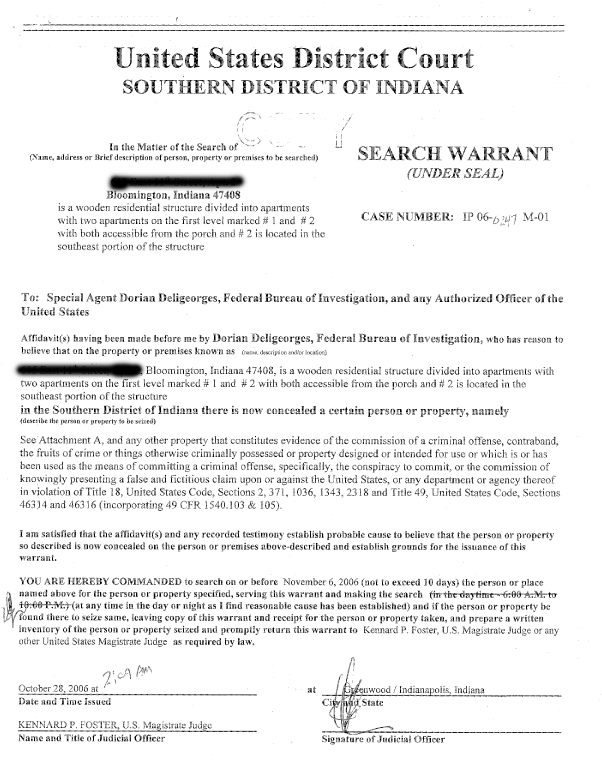
Technicians and Police Officers are incompetant. If you want to find a stolen laptop you contact a professional to get the job done. When you file a stolen vehicle report with the police, police computers send a silent radio signal to your car, automatically activating the hidden LoJack transmitter in your vehicle. Police can then track the signal and locate the vehicle. How do you report a stolen laptop to the police? Then the school is notifed to use the software to locate the laptop. With the way webcam theft tracking works, we'll need a new type of search warrant: Location To Be Determined After Search. When these laptops wake up and retrieve orders to activate their webcams, they can literally be anywhere. Bergen County school district has 2,100 students in two high schools and they use a tracking system to locate missing or stolen laptops by using [a computer's Internet] address, then police obtain a search warrant to check for the laptop. In the Henrico County, Va., public schools, about 26,000 laptops have been issued to students and the remotely operated Web cams are disengaged until a computer is stolen and reported to the police. In California, the Fullerton Elementary School District provides laptops to its pupils but - like Henrico County - it requires a reported theft before security measures are activated. The school system's technology director can turn on the camera only after the theft has been reported to police and the number of the report is entered, officials said. Police need a search warrent . If you don't know where to look and just activate the software to look you may find out that the stolen computer is somewhere you shouldn't be looking, like a child's bedroom or SKIF . So how will you fill out a webcam search warrants? How is that going to work?
Lillie Coney of the Electronic Privacy Information Center "If they thought it was right, they wouldn't have stopped. "But they weren't thinking. And they weren't planning to get caught. So they didn't tell anybody." "We've been conditioned to think we'll give up anything for security, but people have more say about these things than they think."
Put another way, principals may rule at school, but students' homes must remain a refuge. "For this school district to develop police powers in secret and then exercise those powers in secret," she said, "is problematic and disturbing."
If you tried to Protect your Privacy then jail breaking was grounds for explusion.
Parents are citizens who may be ignorant of their rights and not realize that it's wrong, and don't realize it's spyware and think they have signed their rights away when they accept the free computer, but should protest.
Missing the Boundary Line is Key:
The Police Were Not Called.
This particular laptop has never been asserted to be lost,
stolen, misplaced, or missing.
If you are using it to locate stolen property you would call the
police right? If software is used to watch what children are doing,
that is spying.
ADMINISTRATORS ARROGANCE: NOT THE FIRST COMPLAINT
Student representatives had twice objected to the program's
intrusiveness to the school administrators and had been ignored.
Leardership Starts From The Top of the state. PENNSYLVANIA
INFORMATION TECHNOLOGY
|
on paid leave Michael Perbix, a network technician
, and
|
THE LOWER MERION NETWORK TECHNICIANS
1) Brad Miller 312 Davis Road Havertown, PA 19083 [p] 610-853-1161
2) Jeremy Valentine 1378 Indian Creek Dr. Wynnewood, PA 19096 [p] 610-896-469
3) Mike Perbix Network Technician has been blogging and posting on
Apple mailing lists how he did it.
Mike Perbix
talks about spying with Remote Desktop Curtain Mode
Lower Merion School District Telecommunications Specialist
[e]
PERBIX@lmsd.org
(610) 645-1964 - Work
(610) 896-2019 - Fax
Open Subscriber
Stryde Hax , who says he works for the security firm Intrepidus Group, strydehax [e] stryde dot blog at gmail dot com did a brilliant job looking into sleuthing this out!
"Mike Perbix has a large online web forum footprint as well as a personal blog. During our testing, we infected a laptop with LANRev, then closed the lid, hoping to activate the LANRev feature which takes a webcam picture when the computer wakes. As my colleague Aaron opened the lid of his Mac, the green webcam light flickered, ever so briefly. It wasn't a glitch. It was a highly sophisticated remote spy in his system. And even though he was in control, the effect was still very creepy.
LANrev contains a security hole that put the students at risk of being spied on by people outside the school, according to a security firm that examined the software. The LANrev program contains a vulnerability that would allow someone using the same network as one of the students to install malware on the laptop that could remotely control the computer. An intruder would be able to steal data from the computer or control the laptop webcam to snap surreptitious pictures.
See the LanRev remote monitoring product Promo where
"Mike Perbix identifies himself as a high school network tech, and then speaks at length about using the track-and-monitor features of LanRev to take surreptitious remote pictures through a high school laptop webcam. A note of particular pride is evident in his voice when he talks about finding a way outside of LANRev to enable "curtain mode", a special remote administration mode that makes remote control of a laptop invisible to the victim. Listen at 35:47, when he says: "you're controlling someone's machine, you don't want them to know what you're doing" ~Mike Perbix
It isn't until 37 minutes into the video till Perbix begins talking about the Theft Tracking feature, which causes the laptop to go into a mode where it beacons its location and silent webcam screenshots out to an Internet server controlled by the school."
Mike Perbix: disable firmware lock intel laptops
* Subject: Re: disable firmware lock intel laptops
* From: "Perbix, Michael" <email@hidden>
* Date: Wed, 21 Oct 2009 19:30:37 -0400
OFPW (the latest version) is a universal binary and works. OFPW
-command 0
will turn it off.
You could also use NVRAM, built in to the OS....
Sudo nvram -p shows you all the variables currently in your nvram....
sudo nvram security-mode=none
Turns off security, to turn it on
sudo nvram security-mode=command
To set the password, you need to know the encrypted version of it....set the password on another machine, then use sudo nvram-p to see it, copy the encrypted form of the password and use
sudo nvram security-password=<place encrypted password here>
sudo nvram security-mode=command
I use this from LANrev and sending unix scripts to set users
firmware
passwords that may be wrong....or missed during a service call.
You can script a firmware password check script using openssl so that you don't have to put the weakly encrypted password in a visable script...
http://bestsinceslicedbread.blogspot.com/2009/09/compare-secure-values.html
I started documenting things I do like this in my blog...if you can
call it
a blog 8-)...
-Mike
On 10/21/09 6:36 PM, "nate st.germain" <email@hidden> wrote:
try using this utility: http://code.google.com/p/efipw/
sudo efipw -p "" should set the pass to nothing.
sudo efipw -d will decrypt it.
>
> On Oct 21, 2009, at 6:32 PM, Bob Henry wrote:
>
>> Can anyone direct me to a CLI solution to turning firmware
protection off on mac books?
>> I scraped this off my shoe:
>> /usr/local/bin/OFPW -pass mypassword
>> /usr/local/bin/OFPW -mode 1
but seems that OFPW is a PPC util. Please advise TIA
Bob Henry IT & DATA Wrangell Public Schools 907-874-2321 x244
Michael Perbix
Lower Merion School District
Network Technician
http://bestsinceslicedbread.blogspot.com
He describes using the remote monitoring feature to locate a stolen laptop:
Turning off the Lightspeed LsSaAlerter in OSX
We were having an issue with LsSaAlerter application which is part
of the Lightspeed systems Security Agent for OSX. the LsSaAlter
application is responsible for the menu bar icon that shows you the
status of the security agent and what it is currently doing. There
is also a shortcut to get to the Lightspeed Preferences Pane by
clicking on the menu icon.
There does not appear to be any current way via filtering policies
to disable that menu and even if you MANUALLY go into the
com.lightspeedsystems.securityagent.plist and set the "Enable
Manger" key to false, it resets on next logout/login.
So, to manually force that option we look to Apple's MCX system that
we use to manage our laptops via group policy. Using the Workgroup
Manager application, we select the computer group and click on
PREFERENCES, then click on the DETAILS tab. Click the little +
symbol at the bottom and find the Lightspeed preference file and
load it in making sure you are loading it into the ALWAYS category.
The preference file is found at
/Library/Preferences/com.lightspeedsystems.securityagent.preferences.plist
Once loaded, click on the EDIT symbol (little pencil) next to the +
and - buttons, and expand the ALWAYS selection. Click on each entry
and hit DELETE to remove it. The only entry you wish to remain is
"Enable Manager" which should be set to boolean and false. This
allows the other items to still be controlled by the filtering
policy.
Now, next time your clients in that computer list refresh their
preferences, the menu item will no longer be present.
BTW, this is a good way to force preferences for many third party
programs that support PLIST preference files. Of course, it is good
to test, and you may have to use OFTEN or ALWAYS. Always means that
the preference can NOT be changed...OFTEN means it sets the
preference on login, and can be changed, but on next login the
preferences will be reset to what you want them.
Sunday, September 13, 2009
Enable and Disable the built in iSight.
This can be accomplished by changing the permissions of 2 files. It
can be done by removing rwx for all users (ie chmod a-rwk) on the
following
/System/Library/QuickTime/QuickTimeUSBVDCDigitizer.component/Contents/MacOS/QuickTimeUSBVDCDigitizer
/System/Library/PrivateFrameworks/CoreMediaIOServicesPrivate.framework/Versions/A/Resources/VDC.plugin/Contents/MacOS/VDC
This has been tested on OSX 10.5.7 (MacBook) and OSX 10.5.8 (MacBook
Pro)
A DMG with the completed script and application can be found
here
.
The script should go somewhere in your path (/usr/sbin or such) and
have the appropriate permissions and owner. You can then run it from
a utility such as ARD or LANrev, or from a SSH login by issueing the
command with the appropriate option use -h or -help for info.
The Application has a copy of the isighter script contained in it's
bundle. The actual Applescript is an example of how to run a
terminal command with admin privileges and can be found
here
.
ENJOY!
Posted by Michael Perbix
strydehax
explains that "Perbix
puts it in context on an admin newsgroup
, in a post which makes it clear that his script allows for the
camera to appear shut down to user applications such as Photo Booth
but still function via remote administration:
"what this does is prevent internal use of the iSight, but some
utilities might still work (for instance an external application
using it for Theft tracking"
What's the purpose of shutting down a camera for the user of the laptop but still making it available to network administrators? Ask yourself: if you wanted to convince someone that a webcam blinking was a glitch, would disabling the cameras help make your case?"
" Posted on digg and SAC: ""As a recent graduate of Harriton, I thought I could shed some light on the situation. These laptops were 2.0ghz 2gb Macbooks issued out to all the students for the entire year to do whatever they wanted and this was the 2nd year of the program. The webcam couldn't be disabled due through tough tough security settings. Occasionally we would notice that the green light was on from time to time but we just figured that it was glitching out as some macbooks do sometimes. Some few covered it up with tape and post its because they thought the IT guys were watching them. I always thought they were crazy and that the district, one of the more respectable ones within the state, would never pull some s*** like this. I guess I was wrong. I am a little surprised because nobody in the past had be disciplined for doing anything inappropriate during school or outside of school. The only thing coming close was a kid performing a simple hack to make another account in order to install games. This specific incident was traced through the network by the IT dept. While I still think there might be a chance the vice principal/ disciplinarian doesn't have these specific images as she is quite the type to make a bluff like that, it sounds to me like this is legit. If they have been watching all of us and looking at our logs and looking at what we type, I can assure you that they have seen lots and lots and lots of dirty things."" "
" I am the father of a 17 y/o Harrington High student. She has had one of these laptops for 2 years. She has noticed the "green light" coming on but was not computer literate enough to know what initiated it. While it is true that frivolous law suits exist, there are many suits that are found to be true. The LMSD has helped create an atmosphere of distrust in their community. It should be no surprise that parents do not automatically come to their defense.My daughter's noticing the light on her laptop was identified prior to any news of a laptop. The assumption was that it was a defect. That is now not as clear. "Were students and families explicitly told about the laptop security system?
Removing Webcam Tracking feature from Laptops at LMSD
Strydehax Update 2/23/2010 11:28am
Aaron Rhodes says the reason LANRev is using the raw camera device
is that
Apple implemented security measures to prevent remote activation
of the webcam
in OSX.
LANRev was designed to bypass this security measure
. Ask yourself, "what kind of software bypasses OS security
measures?"
On the topic of whether or not we yet have proof of illegal use, I
would ask you to listen carefully to the webcast, and listen for the
word "house" at 1:28. Listen for "yes we have used it."
THE AUP
- Staff Access to Networked Information Resources Acceptable Use Policy PDF
- Administrative Regulations for Staff Acceptable Use Policy PDF
- Staff Network Account Request Form PDF
- Student Network Access Policy PDF
-
Student Guidelines
PDF
Educational Technology for the 21st Century
• Use of district technology for communication and operations
• Guide students to the understanding and adherence of guidelines
for acceptable use of technology
• Awareness and use of technology resources
• Basic knowledge and use of district network
• Awareness and development of age appropriate technology
competencies for students
• Apply technology tools to best practices for teaching and learning
Supervisor of Instructional Technology - Jason Hilt
Administrative Assistants - Andrea Papsin. Sherry Zielke
Webmaster - Jason Michael
SIS Support Technicians - Jessica Bolton, Jim Roletter
Desktop Technician - Chuck Ginter, Jim Wills
Helpdesk Technician - Amanda Wuest
Audio/Visual Technician - Jim Rigby
Building Level Technology Support - Tom Crocker, David Feight, Kyle
O'Brien, Neil Pancoast, Matt Shaw, Matt Stanford
Building Level Instructional Technology Specialists - Beth Hampton,
Rhonda Keefer, James Langmayer, Tom McGee, Andy Pron
In this episode we show you how to take a
USB web cam and turn it into a spy camera.
Further Reading:
Why K-12 School Districts should be using Open Source Software Technology
Trusted Computing is controversial as the hardware is not only
secured for its owner, but also secured against its owner as well.
Such controversy has led opponents of trusted computing, such as
Richard Stallman
, to refer to it instead as
"treacherous computing"
, even to the point where some scholarly articles have begun to
place scare quotes around "trusted computing".
Trusted Computing opponents such as the Electronic Frontier
Foundation and Free Software Foundation claim trust in the
underlying companies is not deserved and that the technology puts
too much power and control into the hands of those who design
systems and software. They also believe that it may cause consumers
to lose anonymity in their online interactions, as well as mandating
technologies Trusted Computing opponents deem unnecessary. They
suggest Trusted Computing as a possible enabler for future versions
of mandatory access control, copy protection, and
digital rights management
.
Some
security experts
have spoken out against Trusted Computing, believing it will provide
computer manufacturers and software authors with increased control
to impose restrictions on what users are able to do with their
computers. There are concerns that Trusted Computing would have an
anti-competitive effect on competition in the IT market.
There is concern amongst critics that it will not always be possible
to examine the hardware components on which Trusted Computing
relies, the Trusted Platform Module, which is the ultimate hardware
system where the core 'root' of trust in the platform has to lie.
The whole focus is on giving the system operator lots of flexibility to do whatever they want , while giving customers, experimenters, competitors, and citizens zero flexibility or opportunity.
If not implemented correctly, it presents a security risk to overall platform integrity and protected data . The specifications, as published by the Trusted Computing Group, are open and are available for anyone to review. However, the final implementations by commercial vendors will not necessarily be subjected to the same review process. In addition, the world of cryptography can often move quickly, and that hardware implementations of algorithms might create an inadvertent obsolescence. Trusting networked computers to controlling authorities rather than to individuals may create digital imprimaturs.
The Cambridge cryptographer Ross Anderson has great concerns that "TC can support remote censorship [...] In general, digital objects created using TC systems remain under the control of their creators, rather than under the control of the person who owns the machine on which they happen to be stored (as at present) [...] So someone who writes a paper that a court decides is defamatory can be compelled to censor it — and the software company that wrote the word processor could be ordered to do the deletion if she refuses. Given such possibilities, we can expect TC to be used to suppress everything from pornography to writings that criticize political leaders." He goes on to state that:
[...] software suppliers can make it much harder for you to switch to their competitors' products. At a simple level, Word could encrypt all your documents using keys that only Microsoft products have access to; this would mean that you could only read them using Microsoft products, not with any competing word processor. [...]
The [...] most important benefit for Microsoft is that TC will dramatically increase the costs of switching away from Microsoft products (such as Office) to rival products (such as OpenOffice). For example, a law firm that wants to change from Office to OpenOffice right now merely has to install the software, train the staff and convert their existing files. In five years' time, once they have received TC-protected documents from perhaps a thousand different clients, they would have to get permission (in the form of signed digital certificates) from each of these clients in order to migrate their files to a new platform. The law firm won't in practice want to do this, so they will be much more tightly locked in, which will enable Microsoft to hike its prices.[7]
Ross Anderson summarizes the case by saying
"The fundamental issue is that whoever controls the TC infrastructure will acquire a huge amount of power. Having this single point of control is like making everyone use the same bank, or the same accountant, or the same lawyer. There are many ways in which this power could be abused."
Microsoft Spy
- 17-page Microsoft Global Criminal Spy Guide. Its programs, make it
easier for law enforcement to obtain user data, violations of trust
toward its customers. For a large corporation with millions of users
and an aggressive PR agenda, the document raises concerns and sparks
conversations the company would rather not confront.
"It's part of a very intense political debate about the role of
intermediary companies like Microsoft aiding surveillance for law
enforcement. It's embarrassing for Microsoft for their users to see
how much the people who carry their email have arrangements with law
enforcement... All of the people who carry our communications are an
easy conduit for our government to spy on us, and a lot of people
are unhappy about that.
Is your data encrypted? 45 state privacy laws - Only Safe
Harbor-Data Encryption
Almost all states and the federal government have enacted or plan to
enact legislation requiring notification of security breaches
involving personal information. Many existing state and federal
privacy laws have also gained teeth recently-including stiff
penalties in some cases. These include:
- MA 201.CMR.17 - The new model for privacy laws, Massachusetts's recent legislation mandates encryption and even impacts companies in other states (compliance deadline extended to March 1, 2010)
- CA SB1386 - If you handle data for residents of the country's most populous state, California, you must notify individuals if a breach occurs-unless the data is encrypted
- NV SB 227 - Vendors in Nevada must now comply with the Payment Card Industry Data Security Standard (PCI DSS)
APPLE CLASSROOMS
OF TOMORROW
What a nightmare!
THE APPLE COMPUTER
is marketed to all the School Districts and the District Lawyers
and Technologists aren't experts who know the issues or
understand the law which is no excuse.
Just because there is
an
AUP
doesn't mean the school district has the right to spy on citizens.
Hard working, well meaning, sincere, but ignorant employees of the
school systems in this country are enabled to buy the computer
technology with your tax dollars using
government funds - and apple wants the easy money.
Apple
sold
these computers
to the School District. Apple makes a lot of money when it promotes
the
Understanding of 21st Century Skills and Outcomes Curriculum
.
Can Apple prove they informed the School District that the webcams
should not be used to spy on children?
Apple should be held accountable for telling the School District
what to include in the AUP. Apple needs to be investigated and
possibly prosecuted for negligence if they did not take
responsibility for giving the school district an AUP for the
parents.
This school document
identifies the hardware and software in use as Macbook laptops
running OSX.
Apple Remote Desktop 3
: Administrators have access to the laptop of every kid in the
school through this program, and can switch from one to another and
watch what the kids are doing on their computers in real time.
Remote observation and control of target computers is plainly listed
in the
Apple Remote Desktop 3 Feature List
.
Webcameras are enabled by the IT department to allow Administrators
to see their screens, and faces and communicate with th student and
take a picture of them (admins can control their laptops remotely)
in Photo Booth, or interrupt their IM conversation with their own
message. No one informed the kids that they were being monitored.
Even if the laptops don't belong to the student, so should have be
able to expect privacy. The potential for abuse is nearly limitless,
especially since many teens keep their computers in their bedrooms.
Even when a non-IT employee clearly is to blame for a security breach, IT is still responsible.
Dan Morill ~ "We need to remind ourselves again and again that information security is not a technology issue - it's a people issue. We are reliant on people, their awareness, ethics and behaviour, and we must understand what they want to achieve if we are to accomplish the goals of business. This includes the employees that deliver our services and the customers that take advantage of them, as well as the senior executives and board room directors that grant us our budgets."
Guidelines for Use of Student Laptops
1
The laptop computers that will be issued to all high school students
are the property of Lower Merion School District
. Students are responsible for the appropriate use of these laptops
both at school and at home. The laptops are for the use of students
for educational purposes. All commercial, illegal, unethical and
inappropriate use of these laptops is expressly prohibited.
Students are to comply with copyright laws. Downloading games or
software is expressly prohibited. Only District licensed software is
to be installed on the laptops.
The maintenance of laptops is the student's responsibility. If
laptops need repair or maintenance students are to report to the
Technology Center in their building. Vandalism to any laptop or
accessory is strictly prohibited. Students must present school
issued picture ID when they bring their laptop in or pick up from
repair.
Students should refer to the Student Acceptable Use Policy and their
Guidelines. Any violation will be subject to discipline as outlined
in the Harriton and Lower Merion Student Guide.
High school teachers will distribute laptops during Advisory period
on September 8, 2009. Laptops will have a label containing the
student's name and other information specific to the laptop for
identification.
APPLE SALES PITCH TO SCHOOLS
Creating a 21st Century Learning Environment with Anytime Anywhere
Access to Digital Resources
The major goals of this initiative are to provide students with 21st Century learning environments both at home and in school, and to give all students access to technology resources. We have the opportunity and the responsibility to utilize research-based, technology-enabled practices to inspire and capture the imagination of our students. LMSD seeks to create a learning environment that fosters deeper cognitive development through inquiry, real and relevant project-based learning, and differentiated instruction - all supported by continuous access to digital technologies. Students will have the ability to work on projects and research both at school and at home. They will have 24/7 access to the software that they use in school. We believe that the laptop is an essential tool to assist them in thinking critically, analyzing data, solving real world problems and publishing their work.
- Letter to Parents
- Letter to LMHS Parents
- Letter to HHS Parents
- 21st Century Learning FAQ
- Classrooms for the Future
- Measuring What Really Matters
- Insurance Payments
- Getting Started Guide for Students
- Student Helpdesk Login
- Student Printing
- Home Filtering Letter
- One to One Printing and Filtering at Home
- For more information about the topic(s) covered on this page, please email email_link("laptopfaq","lmsd.org","Letter to HHS Parents"); laptopfaq@lmsd.org .
YOU ARE ON PAGE 2